‘Don't let auteurs take over in theatre. Elevating the director to cult status at the expense of the writer is the road to Hollywood's creative bankruptcy: keep the dramatist at the heart of the creative process.’ That’s not me, that’s the intro to a recent blog post from Britain’s Michael Billington. Hmm …
I’m a playwright, so of course I want space for writers to practise and develop their craft. Support for writers to initiate and develop their own ideas, as well as work on projects dreamt up by others. Opportunities to collaborate with different artists in the creation of work across the whole spectrum of theatre and performance. But what troubles me about Billington’s post is his notion of 2 discrete entities: a ‘writers’ theatre and a ‘directors’ theatre. And the implication that the rise of one presages the decline of the other. Isn’t it time we chucked this division in the bin? Isn’t it more useful to think instead of the whole ecology? Speaking for myself, I want to write for a range of forms, and work in a range of ways with a range of other artists. And maybe this is naïve or overly idealistic, but isn’t it far more likely that really good work in one area will encourage really good work in another, rather than jeopardise its existence?
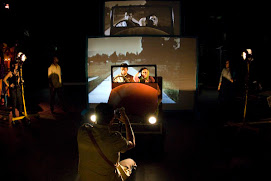
This issue has particular currency for me as I’ve just returned from Melbourne and a week’s workshop with The Eleventh Hour on a new theatre project with the working title Debts. Drawing inspiration from Shakespeare’s The Merchant of Venice, and from the various incarnations of Christopher Isherwood’s Berlin stories, including the film Cabaret, the project is looking at debt and notions of indebtedness. The concept is the brainchild of the company's artistic directors; as the writer, I am also contributing ideas (as well as text) and will help shape the piece; the actors likewise have input into the development of Debts. In other words, the work is collaborative, and is being created not solely by the playwright, not solely by a director or auteur, but by a team of artists with specific skills and roles. And isn't this the case with most theatre? Even if you sit in front of your computer and write a play with no involvement from anyone else, you're going to rely on collaborators to realise it as theatre, and unless you're a total control freak, those collaborators are going to participate in the creation of the work as theatre.
Last week's workshop was the first stage of our creative development, and I had a great week with directors/dramaturgs Anne Thompson and William Henderson, and actors Jane Nolan, Rodney Afif and Greg Ulfan. I’d contacted the company about 18 months ago, because I really liked what I'd read about them and thought they sounded like a company of substance rather than PR hype. (Which they are, by the way.) The invitation to collaborate on Debts came out of this initial dialogue.
Naturally we discussed our ideas for the piece around the table, but every day also involved plenty of work on the floor. Experimenting, trying out things, exploring possibilities, looking at what happens when you crash and juxtapose different texts, genres and styles. For a playwright this is fantastic, because I get to see how things might work theatrically—or not. It forces you to think performatively, of bodies in space, of words in mouths. It reminds you that sentences and situations that read brilliantly on the page may not be effective on stage; it encourages you to wrestle, question and rhapsodise. You bounce ideas around the room, off each other, and those ideas keep on bouncing around in your head as you board QF462 back to Sydney, as you do the weekend shopping, and days later as you walk along the foreshore at dusk.
2 more workshops/creative developments are scheduled for July and August.
Showing posts with label cabaret. Show all posts
Showing posts with label cabaret. Show all posts
19 April 2009
26 January 2009
From Taishō Chick
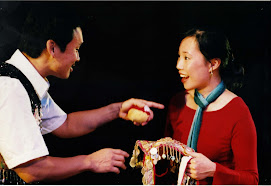
This is an excerpt from Taishō Chick, a cabaret/spoken word piece I wrote for Asako Izawa as part of the Art Gallery of NSW 2008 exhibition Taishō Chic. It came to mind as I began thinking about Shop Girl, another short script I'm writing for Asako and koto player Satsuki Odamura. Shop Girl is the story of a Japanese woman who defects to North Korea, hoping to find movie stardom in the Stalinist state. It's evolved from a creative development we did a couple of years ago (funded by the Theatre Board of the Australia Council and Sydney University Department of Performance Studies) and from my enduring interest in North Korea. Our plan is to produce Shop Girl in 2009.

Here's that excerpt from Taishō Chick:
…
In times of change I open the dictionary.
Not literally, but to open a crease in the language and reveal what we couldn’t say yesterday
in public
we drummed out syncopated rhythms with chopsticks. Drew cartoons with cold coffee on table tops.
Painting was my way of walking into the heart of the world without anybody knowing I was shy.
A taxi over the bridge, a little avant-garde introspection in the shade of the willow trees, and rice riots—that’s rice, R-I-C-E, not race. The poor were being bossed around by the high cost of rice.
For the not-so-poor
It was the age of silk stockings, foxtrots and all that jazz.
Of department stores and opinions—remember, long before the iPod brought music to our ears, the I-novel brought us first-person narratives.
I look for myself
and find
a café waitress lining up her future. Irie Takako starting her own film production company. Journalists reporting the latest from Paris or Shanghai. Young men in suits tailored British style.
And the key to all this activity?
The city.
The adventures and affairs of the metropolis …
Here's that excerpt from Taishō Chick:
…
In times of change I open the dictionary.
Not literally, but to open a crease in the language and reveal what we couldn’t say yesterday
in public
we drummed out syncopated rhythms with chopsticks. Drew cartoons with cold coffee on table tops.
Painting was my way of walking into the heart of the world without anybody knowing I was shy.
A taxi over the bridge, a little avant-garde introspection in the shade of the willow trees, and rice riots—that’s rice, R-I-C-E, not race. The poor were being bossed around by the high cost of rice.
For the not-so-poor
It was the age of silk stockings, foxtrots and all that jazz.
Of department stores and opinions—remember, long before the iPod brought music to our ears, the I-novel brought us first-person narratives.
I look for myself
and find
a café waitress lining up her future. Irie Takako starting her own film production company. Journalists reporting the latest from Paris or Shanghai. Young men in suits tailored British style.
And the key to all this activity?
The city.
The adventures and affairs of the metropolis …
Subscribe to:
Posts (Atom)
+Photo+Leah+McGirr+3.jpg)