My poem Salt Lemon has just been published in Black Market Review, Issue 2 (Spring 2010). You can read it here.
Lot of heat in the blogosphere about the NSW Premier’s Literary Awards judges’ decision that no plays this year are worthy of nomination. Currency Press have issued a media release (which seems to have disappeared from their website, but you can read it here on James Waites' blog), but I think the best discussion is—perhaps not surprisingly—at Theatre Notes. Let’s use the NSW judges’ omission to have a real discussion about performance writing—what it is, and what it might be.
I’ve left a few comments around the traps, including on the Australian Literary Review blog. Unfortunately the responses there (those that aren’t in-crowd chit-chat about the event where the short-list was announced) dump on Australian performance writing. Sigh.
BTW I didn’t enter a play, so have no personal axe to grind.
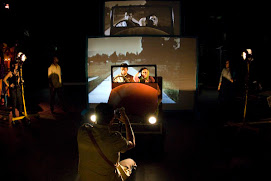
Screens and projections have become commonplace in theatre. Sometimes the footage is well shot and/or designed, sometimes not. Sometimes they’re imaginatively and deftly used, sometimes not. Sometimes they add, sometimes they diminish.
Combining recorded images and on-stage action is a complex and intricate business. As is fusing deferred and live performance. I’ve seen productions with lavish and costly projections that have been pretty ho-hum, and incredibly simple set-ups that worked brilliantly. Success is obviously down to more than technology and resources (although they help).
You’re probably sensing a ‘but’ here …
Screens, both individual and public, are a feature of contemporary life. As theatre-makers of course we want to reference and make use of them. But this ubiquity also prompts reservations. When many of us spend so much of our time gazing at screens on computers, iPhones, tablets, TVs, etc. do we—do I—want to go to the theatre for more of the same?
I have mixed feelings about this, and certainly nothing per se against the use of screens on stage … but there is something unique and compelling about the live, unmediated exchange. I love the directness of stand-up, of spoken word and poetry. Of readings. Of the guided tours you bump into. Of the everyday, happenstance performances you come across in supermarkets and department stores (such as cooking demonstrations) and in malls (spruikers and the like). Although perhaps my preference for these bare-bones, solo forms reflects nothing so much as my current disenchantment with theatre, much of which I’m finding limited, over-reliant on a handful of easy, predictable tropes, even—dare I say it?—intellectually banal.
But let’s end on a more up-beat note. One of the most stunning theatrical combinations of live performance and projections I’ve seen was Between the Devil and the Deep Blue Sea from UK company 1927. Catch them on YouTube.
And the good news is: they’re returning to Sydney with a new show later this year.


It’s the brainchild of the dynamic Gus Supple, and this is what she has to say about it:
Thousands of people everyday travel on the buses and trains of Sydney—to work, to school, to meet friends or family. Though a necessary part of life in the city, public transport is an unknowing catalyst to creation. Many of us use our train or bus rides to message friends, read a book, write a card, read a newspaper, make notes in a diary. And the buses become a form of mobile office, taking us from A to B while we make plans or take notes.
Harnessing the talents of some of Sydney’s most dynamic writers, Stories from the 428 finds the sublime and extraordinary in the everyday bus ride and transports it on stage.
Inspired by conversations, scenes from the bus window, overseen text messages or perhaps the person sitting across from them, a group of 8 playwrights per week will collaborate to create a unique and surprising theatrical experience centred around the 428 bus route.
I was drawn to this for a number of reasons, but 2 in particular. I’m a passionate advocate for public transport, (I haven’t had a car for years) and in the late 1990s I lived in Dulwich Hill and travelled frequently on the 428 bus. My second main reason for joining Stories from the 428 was that it was all going to happen fast, fast, fast. We’d catch the bus, write our scripts, rehearse, and put them on over the course of a couple of months. When the gap between starting to write a play and opening night can stretch for years, this appealed to me. By way of contrast, I began Songket early 1997 and by the time it finally went on mid 2003, I had to work hard to rekindle my interest. To paraphrase the announcers on the London Underground: Mind that gap!
Stories from the 428
Week One: Wednesday 24—Saturday 27 March at 8:00 pm & Sunday 28 March at 5:00 pm.
Week Two: Wednesday 31 March--Saturday 3 April at 8:00 pm & Sunday 4 April at 5:00 pm.
Sidetrack Theatre, 142 Addison Road, Marrickville. (The 428 bus stops just outside.)
In the meantime, check out the project’s website: http://www.storiesfromthe428.com/ and Facebook page.
+Photo+Leah+McGirr+3.jpg)