Just read Surviving New Labour as an artist: Artistic independence and the pitfalls of state funding by British artist Jan Bowman.
The debate about ‘doing it yourself’ or ‘artistic downshifting’ in the words of writer and film-maker Kathryn Millard, goes on. As technological developments create new platforms and possibilities, and government funding becomes scarcer and more prescriptive, there’s a lot to be said for writing outside the system. A couple of years ago I spent several weeks writing applications, several weeks hard-chiselling round pegs to fit into funding bodies’ boxes. Only afterwards did I wonder about all the time spent filling out forms, composing punchy synopses, and justifying processes; time I would otherwise have spent writing a script or an essay, a story or poem—something real, and useful.
26 October 2007
26 September 2007
Postcard from OzAsia
Just back from the OzAsia Festival Symposium, and thinking about that whole vexed issue of using economic arguments to justify support for the arts. This was a tension throughout the weekend—and not always an underlying one.
In the last few years the favoured argument seems to be that a robust arts community increases the ‘liveability’ of a city or state, increasing its attractiveness for business investment, thereby providing jobs, et cetera, et cetera. What concerns me is not so much the truth or otherwise of these assertions, but the fact that we’ve jettisoned the language of culture and aesthetics in favour of the language of economic-impact studies—the language of politicians, in other words. And I think this concession, this shift to economic rather than cultural argument, is dangerous.
It’s dangerous because—thanks to widespread cultural illiteracy and a largely debasing mass media—most Australians have no idea why public support for the arts is worthwhile. So even though politicians tell us we’re living in an era of unprecedented (material) prosperity, the arts are starved of vital subsidy, and arts education is sidelined as irrelevant to the New World Economy. Then in a stroke of Orwellian cunning, that lack of appreciation is used as a rationale to continue not funding the arts.
Back to OzAsia, an excellent and much needed initiative, putting a bit of cultural diversity back onto the arts table. A table which—after a brief 1980s/early 90s flirtation with rye and pitta and Vietnamese pork rolls—has reverted to white sliced. (Although I must admit that when I read clunky sentences like: ‘Australian artists that identify with an Asian heritage’ various bells start ringing.) The symposium brought together practitioners, academics, arts administrators and representatives from a range of funding and state and federal organisations. So saying … when governments use the arts to spearhead trade programs or diplomatic initiatives, what companies and kinds of work do they chose to sponsor? Large dance companies, classical music ensembles, circuses? Productions guaranteed to make a big splash. But what about that small group of independent artists developing a more risky or experimental project, or beginning a long-term collaboration? Thank goodness then for Asialink, who seem to understand that professional relationships are built slowly, and that good work, especially that which crosses the boundaries of language and geography, takes time as well as resources.
The highlight of the symposium for me was undoubtedly the keynote paper from Calcutta-based writer, theatre director, cultural critic and independent scholar, Rustom Bharucha. It’s difficult to summarise because of the wide range and complexity of the issues he addressed. But here goes … Drawing on his 2006 book Another Asia, he exposed the capitalist bones of this hugely heterogeneous body called ‘Asia’, queried the word ‘enmeshment’, explored issues of nationalism, exchange, creative process, community, intercultural dreaming—and much, much more. It was passionate and provocative, eloquent and erudite, and I only wish there had been more time to discuss some of the ideas he raised.
Seems appropriate then to end with this favourite quote from Edward Albee: ‘Theatre tells us who we are, and the health of the theatre is determined by how much we want to know.’
In the last few years the favoured argument seems to be that a robust arts community increases the ‘liveability’ of a city or state, increasing its attractiveness for business investment, thereby providing jobs, et cetera, et cetera. What concerns me is not so much the truth or otherwise of these assertions, but the fact that we’ve jettisoned the language of culture and aesthetics in favour of the language of economic-impact studies—the language of politicians, in other words. And I think this concession, this shift to economic rather than cultural argument, is dangerous.
It’s dangerous because—thanks to widespread cultural illiteracy and a largely debasing mass media—most Australians have no idea why public support for the arts is worthwhile. So even though politicians tell us we’re living in an era of unprecedented (material) prosperity, the arts are starved of vital subsidy, and arts education is sidelined as irrelevant to the New World Economy. Then in a stroke of Orwellian cunning, that lack of appreciation is used as a rationale to continue not funding the arts.
Back to OzAsia, an excellent and much needed initiative, putting a bit of cultural diversity back onto the arts table. A table which—after a brief 1980s/early 90s flirtation with rye and pitta and Vietnamese pork rolls—has reverted to white sliced. (Although I must admit that when I read clunky sentences like: ‘Australian artists that identify with an Asian heritage’ various bells start ringing.) The symposium brought together practitioners, academics, arts administrators and representatives from a range of funding and state and federal organisations. So saying … when governments use the arts to spearhead trade programs or diplomatic initiatives, what companies and kinds of work do they chose to sponsor? Large dance companies, classical music ensembles, circuses? Productions guaranteed to make a big splash. But what about that small group of independent artists developing a more risky or experimental project, or beginning a long-term collaboration? Thank goodness then for Asialink, who seem to understand that professional relationships are built slowly, and that good work, especially that which crosses the boundaries of language and geography, takes time as well as resources.
The highlight of the symposium for me was undoubtedly the keynote paper from Calcutta-based writer, theatre director, cultural critic and independent scholar, Rustom Bharucha. It’s difficult to summarise because of the wide range and complexity of the issues he addressed. But here goes … Drawing on his 2006 book Another Asia, he exposed the capitalist bones of this hugely heterogeneous body called ‘Asia’, queried the word ‘enmeshment’, explored issues of nationalism, exchange, creative process, community, intercultural dreaming—and much, much more. It was passionate and provocative, eloquent and erudite, and I only wish there had been more time to discuss some of the ideas he raised.
Seems appropriate then to end with this favourite quote from Edward Albee: ‘Theatre tells us who we are, and the health of the theatre is determined by how much we want to know.’
18 September 2007
Writing Korea & Questions of Connection
I’ve been writing UNREQUITED these last couple of weeks. Immersed again in the singular and surreal reality that is North Korea; obsessed with the huge concrete shell of Pyongyang’s unfinished Ryugyong Hotel. Why a reclusive society like the DPRK, with an economy in cardiac arrest, would need a 105-storey, 3,000-room hotel is—well, a mystery. In a country of mysteries.
Anyway, getting ready to present UNREQUITED at the forthcoming OzAsia Festival in Adelaide, I’ve been thinking about questions of tradition, authenticity and that oft-repeated mantra: art is a universal language. Here’s where I’m up to:
Cultural traditions are porous; authenticity, like El Dorado, is a myth. For any tradition to thrive, the old and the new need to engage in a dialogue with each other. And it goes without saying that what constitutes tradition can be difficult to gauge, and even more difficult to agree upon.
I wouldn’t deny the power of art as a universal language, but would suggest that it’s a more complex contention. For example, the only time I can honestly say that I’ve ever connected with Ibsen, was through a production of A Doll’s House performed entirely in Bengali. I’ve lived happily through King Lear in Korean, and a Vietnamese adaptation of the Albert Camus play Le Malentendu gave me real insight not only into local issues specific to Hanoi at the time of the production, but also into the original 1944 context of the work. In all these cases however, what was transmitted were the storylines, themes and moral dilemmas the playwrights wished to communicate, not their manner of conveying it. So I’d venture that substance is what makes art universal; style places it distinctively, and uniquely, in its own culture.

Anyway, getting ready to present UNREQUITED at the forthcoming OzAsia Festival in Adelaide, I’ve been thinking about questions of tradition, authenticity and that oft-repeated mantra: art is a universal language. Here’s where I’m up to:
Cultural traditions are porous; authenticity, like El Dorado, is a myth. For any tradition to thrive, the old and the new need to engage in a dialogue with each other. And it goes without saying that what constitutes tradition can be difficult to gauge, and even more difficult to agree upon.
I wouldn’t deny the power of art as a universal language, but would suggest that it’s a more complex contention. For example, the only time I can honestly say that I’ve ever connected with Ibsen, was through a production of A Doll’s House performed entirely in Bengali. I’ve lived happily through King Lear in Korean, and a Vietnamese adaptation of the Albert Camus play Le Malentendu gave me real insight not only into local issues specific to Hanoi at the time of the production, but also into the original 1944 context of the work. In all these cases however, what was transmitted were the storylines, themes and moral dilemmas the playwrights wished to communicate, not their manner of conveying it. So I’d venture that substance is what makes art universal; style places it distinctively, and uniquely, in its own culture.
29 August 2007
Playing Yourself
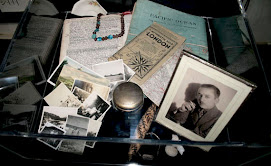
 The Royal Geographical Society, London, circa 1930
David Hare has been in my study again. Not so much as a writer, but as a performer—or more accurately a writer moonlighting as a performer. In 1998 he became an actor—something he hadn’t attempted since he was a teenager. But performing his monologue Via Dolorosa proved a lot more difficult than he’d anticipated, and as a way of coping with the unfamiliar role, Hare kept a diary of the process: Acting Up. It’s an interesting read, not for the famous names he drops, but for the in depth way it explores the tension between the words you write on the page, and the words you speak in performance. What is the difference between acting and performance? And how do you play yourself?
I was re-reading Acting Up as part of preparation for F.R.G.S. A 10-minute Performance Essay for the PowerPoint Age, and my contribution to 7-ON’s The Seven Needs. A piece I wrote for myself to perform; a piece in which I play myself. F.R.G.S. is my second Performance Essay, but the first to be learnt by heart rather than read. For me, this act of memory was the source of greatest anxiety: Yeah, I might be word perfect in my living room and in rehearsal, but what if out there in front of an audience …
Forever ago in London I played the clarinet and saxophone in bands, cabaret groups and fringe theatre companies, but it was obvious to me—and it certainly was to anyone who heard me—that I was never going to be the next Lester Young. So I started writing to escape my limitations as a performer. Now on stage again (fortunately this time minus musical instrument), the experience proved terrifying and empowering in just about equal measure. My sympathy for actors has increased tenfold!
I hit on the idea of these Performance Essays for a couple of reasons. One: I’d always been interested in the traditions of the illustrated lecture and ‘slide night’, and having written some pieces for ABC Radio Eye which mashed documentary, the personal essay and performance, I was interested in adapting that genre for live theatre, and two: I was looking for a solo performance form that would work for me as a writer, i.e. it had to be cheap, portable, and involve absolutely no funding applications whatsoever.
More on this later. In the meantime, back to David Hare and the art of public speaking.
12 August 2007
Representation-lite
With the publication of Lee Lewis’s Cross-racial Casting—Changing the Face of Australian Theatre, and an article about the issue in a recent Sydney Morning Herald, questions of representation are in the spotlight—again. This time the focus is on actors of non-European background, and their absence from main stages. Miss Saigon no doubt excepted. Anyway this flurry of interest got me thinking about representation more generally. An exchange in June in Theatre Notes, Back to regular programming … discussed this vexed issue in relation to gender. The dialogue sprang from an article in The Age about Joanna Murray-Smith, who had apparently written to the Sydney Theatre Company to ask why they weren’t programming her plays. Well, you've gotta admire her chutzpah ...
OK, here’s a view from Sydney on the STC: Yes, it certainly seems harder for a woman to get her foot in the door, even in the (relatively) small door of the variously-named Wharf 2 programs, where from Michael Gow in the early 1990s, to Brendan Cowell in 2007, the artistic directors have all been male. But why is the STC copping all the flack? Wasn’t it Belvoir Company B whose 2005 season included not a single female playwright or director? The perplexing thing there was that no one commented on this—at least not publicly. Does Company B’s strong record of supporting indigenous work buy them immunity from criticism on matters of gender?
Yes, women writers and directors are under-represented on our better-funded stages and over-represented in back rooms and pub basements. And many non-European performers struggle to get cast as anything other than gang members, refugees, and—for Asian actors—doctors. But I wonder how useful it is for us to keep chewing over this issue? Regurgitating essentially the same arguments? Plus ça change and all that. Perhaps in the words of Freedom, it’s time to ‘think outside the square’?
So here are a few thoughts:
· After a brief period in the spotlight, interest in inter-cultural work has waned. We still see overseas examples in festival programs, but for everyone here it seems it’s business as usual. Meaning artists from non-Anglo backgrounds get space to perform their own life-stories, but rarely a space to explore the questing, theatrically transformative agendas available to their White counterparts. (Why has interest in cross-cultural work declined? Would be interested to hear opinions about this … )
· It’s but a small step from representation to the heavy clay of identity politics, and escalating notions of ‘authenticity’. While I appreciate that autobiography and documentary are important genres in post-colonial societies, in that they are often the first places from which marginalised voices can speak and be heard … there’s a world beyond self-portraits.
· Is there really any point lobbying main-stage companies to represent our reality in anything other than a fairly tokenistic way, when they program for a conservative subscriber audience who, it seems, wants above all to see film and TV stars up close and personal? By all means send them your plays, and if they decide to produce them—fantastic. But if their door won’t budge, don’t waste too much energy trying to prise it open.
· Let’s remember that not all theatre writers and directors want to tailor their work and creative practices to fit main-stage imperatives. Sure, we’d like a share of their resources, but sometimes our artistic choices are better served in other contexts.
And finally—
Representation is too often posited as a destination rather than an ongoing process of engagement with the contemporary world. A destination reached through targeted initiatives and programs which can be rolled out like a carpet over any terrain, no matter how unsuitable or inhospitable. (I’m researching carpets at the moment, so they’re on my mind.)
Were these initiatives effective in the past? Maybe. To a degree. But the straight-talk about access and equality of opportunity that was once part of feminist, queer and post-colonial discourses of empowerment has given way as bureaucracies, universities and arts organisations have embraced the rhetoric. Today’s softer, more conciliatory calls for ‘representation’ have none of the rough edges of older demands for justice and transparency. So it should come as no surprise that what these well-meaning exercises produce is rarely any substantive or lasting engagement with diversity, but more often ‘representation-lite’.
OK, here’s a view from Sydney on the STC: Yes, it certainly seems harder for a woman to get her foot in the door, even in the (relatively) small door of the variously-named Wharf 2 programs, where from Michael Gow in the early 1990s, to Brendan Cowell in 2007, the artistic directors have all been male. But why is the STC copping all the flack? Wasn’t it Belvoir Company B whose 2005 season included not a single female playwright or director? The perplexing thing there was that no one commented on this—at least not publicly. Does Company B’s strong record of supporting indigenous work buy them immunity from criticism on matters of gender?
Yes, women writers and directors are under-represented on our better-funded stages and over-represented in back rooms and pub basements. And many non-European performers struggle to get cast as anything other than gang members, refugees, and—for Asian actors—doctors. But I wonder how useful it is for us to keep chewing over this issue? Regurgitating essentially the same arguments? Plus ça change and all that. Perhaps in the words of Freedom, it’s time to ‘think outside the square’?
So here are a few thoughts:
· After a brief period in the spotlight, interest in inter-cultural work has waned. We still see overseas examples in festival programs, but for everyone here it seems it’s business as usual. Meaning artists from non-Anglo backgrounds get space to perform their own life-stories, but rarely a space to explore the questing, theatrically transformative agendas available to their White counterparts. (Why has interest in cross-cultural work declined? Would be interested to hear opinions about this … )
· It’s but a small step from representation to the heavy clay of identity politics, and escalating notions of ‘authenticity’. While I appreciate that autobiography and documentary are important genres in post-colonial societies, in that they are often the first places from which marginalised voices can speak and be heard … there’s a world beyond self-portraits.
· Is there really any point lobbying main-stage companies to represent our reality in anything other than a fairly tokenistic way, when they program for a conservative subscriber audience who, it seems, wants above all to see film and TV stars up close and personal? By all means send them your plays, and if they decide to produce them—fantastic. But if their door won’t budge, don’t waste too much energy trying to prise it open.
· Let’s remember that not all theatre writers and directors want to tailor their work and creative practices to fit main-stage imperatives. Sure, we’d like a share of their resources, but sometimes our artistic choices are better served in other contexts.
And finally—
Representation is too often posited as a destination rather than an ongoing process of engagement with the contemporary world. A destination reached through targeted initiatives and programs which can be rolled out like a carpet over any terrain, no matter how unsuitable or inhospitable. (I’m researching carpets at the moment, so they’re on my mind.)
Were these initiatives effective in the past? Maybe. To a degree. But the straight-talk about access and equality of opportunity that was once part of feminist, queer and post-colonial discourses of empowerment has given way as bureaucracies, universities and arts organisations have embraced the rhetoric. Today’s softer, more conciliatory calls for ‘representation’ have none of the rough edges of older demands for justice and transparency. So it should come as no surprise that what these well-meaning exercises produce is rarely any substantive or lasting engagement with diversity, but more often ‘representation-lite’.
03 August 2007
Part of Being Australian is Feeling Part of Somewhere Else
2 things converged this week. At a 7-ON Playwrights meeting last Tuesday I learnt that the New Theatre in Sydney is celebrating its 75th anniversary with Art is a Weapon (the theatre’s original 1930’s slogan), and I started reading David Grossman’s Someone To Run With. These days I don’t read much literary fiction (far too many family secrets unravelling on windswept coastlines somewhere or other for my taste), but there’s a major dog in a new play that I’m writing, so I’ve been seeking out dogs in literature, and Someone To Run With features a stray Labrador. Anyway, browsing the Internet to locate a copy of this novel, and—thanks to the New Theatre—ruminating on the language-war nexus, I found this:
‘I once thought of teaching my son a private language, isolating him from the speaking world on purpose, lying to him from the moment of his birth so he would believe only in the language I gave him. And it would be a compassionate language … I wanted to take him by the hand and name everything he saw with words that would save him from the inevitable heartaches so that he wouldn’t be able to comprehend the existence of, for instance, war. Or that people kill, or that this red here is blood. It’s a kind of used-up idea, I know, but I love to imagine him crossing through life with an innocent trusting smile … the first truly enlightened child.’
That’s David Grossman, quoted in The Guardian, 16 August 2006. His son, who was in the Israeli army, had been killed a few days previously.
I’m not quite sure why, but Grossman’s plea, and the New Theatre’s resilience, both reminded me that a part of being an Australian is to feel a part of somewhere else.
‘I once thought of teaching my son a private language, isolating him from the speaking world on purpose, lying to him from the moment of his birth so he would believe only in the language I gave him. And it would be a compassionate language … I wanted to take him by the hand and name everything he saw with words that would save him from the inevitable heartaches so that he wouldn’t be able to comprehend the existence of, for instance, war. Or that people kill, or that this red here is blood. It’s a kind of used-up idea, I know, but I love to imagine him crossing through life with an innocent trusting smile … the first truly enlightened child.’
That’s David Grossman, quoted in The Guardian, 16 August 2006. His son, who was in the Israeli army, had been killed a few days previously.
I’m not quite sure why, but Grossman’s plea, and the New Theatre’s resilience, both reminded me that a part of being an Australian is to feel a part of somewhere else.
26 July 2007
The Desk and the Dreaming Space ...

Pusan, 1999
Today I’m surrounded by skyscrapers. Simultaneously immersed in the Cold War theme park that is North Korea, and in the high art/high tech landscape of South Korea. On my desk are pages of notes on the history of concrete, a polythene-covered Penguin Classic, photos of the port city of Pusan, and my notebook from 1999—in which I wrote about an encounter with Chekhov on a winter evening in one of the city’s waterfront bars.
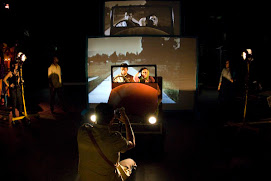
What am I doing? I’m working on UNREQUITED, a 30-minute Performance Essay for the PowerPoint Age which I’m presenting in Adelaide in September. No idea—yet—how I’m going to combine these various strands into a coherent whole. The piece is still in what I like to call its dreaming space: that exciting, early research stage, when curiosity is paramount, and you find yourself pursuing ideas and lines of thought for no apparent or discernable reason—just to see where they might lead …
So apropos of this meandering, here are my 3 favourite tenets from Bruce Mau’s An Incomplete Manifesto for Growth:
6. Capture accidents. The wrong answer is the right answer in search of a different question. Collect wrong answers as part of the process. Ask different questions.
8. Drift. Allow yourself to wander aimlessly. Explore adjacencies. Lack judgment.
9. Begin anywhere. John Cage tells us that not knowing where to begin is a common form of paralysis. His advice: begin anywhere.
Subscribe to:
Posts (Atom)
+Photo+Leah+McGirr+3.jpg)