I've been rethinking my use of both blog and website. My website was designed several years ago, so I'm stuck with categories which no longer reflect my writing practice, which is now a bit less theatre and quite bit more prose and poetry and other things. As for the blog, I haven't added anything in months. And of course the whole online environment has changed, and is continuing to change. So I'm changing too. I will no longer post on this blog or run my old website. (Although they will continue to bounce around in cyberspace: the blog for who knows how long, and the website until my current subscription runs out early 2012.)
My new address is http://noelle-janaczewska.com and it's part website part blog. I'm still working out how I'll use it (I've migrated over the odd favourite from the website) but it will reflect my current writing interests and praxis. Check it out.
25 June 2011
12 February 2011
In praise of complexity
Less is more and simplicity can speak volumes …
As a dramatist I compose what’s said and what is not, words and silence, into a play or performance text. Keep it simple, we’re so often told—at least, I’m often told that—by dramaturgs, directors, critics and others. Like a mantra. But why? What’s so great about simplicity? Why is complication such a no-no?
I like complexity. I think some subjects and situations demand it, and that simplicity can be reductive and flattening. I’ve read and seen a few things recently that, in my opinion, could have done with a few more complications.
The simplicity I mean here is not that distilled and eloquent simplicity that insightful writers sweat to tease from complexity, nor the iceberg structure of a good poem, but a kind of intellectual laziness.
‘We have to remember that what we observe is not nature in itself, but nature exposed to our methods of questioning.’ Werner Heisenberg in Physics and Philosophy. (I think this line also crops up in Michael Frayn's play Copenhagen.)
Sometimes less is just less.
08 January 2011
Readings of jazz poetry from extempore
I'm part of the Readings of jazz poetry from extempore, along with fellow poets Andrew Lindsay, Lynn Hard, Nigel Roberts and Arjun von Caemmerer. Saturday 15 January, 6:00—8:00, at Macleay Bookshop, 103 Macleay Street, Potts Point.

Hope to see you there.

Hope to see you there.
14 November 2010
Shorts & long-term thinking
Haven’t posted for months. Although I have been writing: a play I can best describe as the third ‘first draft’ of a commission; rough sketches of several poems; copious notes for a major non-fiction project, and a monologue. And I was overseas in September, part family visit, part research. For that non-fiction project, and for a collection of poems that I hope will end up as a chapbook.
I’ve also been thinking a lot about what I want to write over coming while—the next few years, at least. It kicked off with a decision not to do any more 10-minute pieces (7-ON gigs excepted). I’ve written quite a few of these, some went OK, some not so OK, and I’m not saying that I’ll never ever write another one ... But here’s my reasoning: while the 10-minuter has its uses and particular pleasures, for me they stopped being ‘opportunities’ and become distractions from the main game. I wasn’t grappling with big ideas and deep creative and intellectual ambition, I was fiddling about on the fringe, in order to feel that I was still on the list of working playwrights.
I emailed these thoughts to 7-ON and we had some great debates—about the pluses and minuses of the short form, about the proliferation of shows, seasons and festivals of short plays. What this explosion reveals about current theatre ecology; how this snapshot form reflects and engages with our digital world (or not); why we’re seeing the names of more and more established and well-established playwrights in program line-ups (interestingly, a trend not replicated by directors), and what that means for new and emerging dramatists trying to catch a break ...
As working writers we constantly reassess and rethink, try different tacks and ways of getting our work into the world. Explore different processes, genres and even artforms. Post Songket in 2003, I set myself the task of writing quickly: 5 weeks to go from concept to a draft solid enough to send out. I also vowed to redraft only when a company and collaborators made a definite commitment to production. I wrote 3 scripts this way. (Redheads, Mrs Petrov’s Shoe and The Stepping Stars of Bóronkowice, which began as a stage play and ended up on radio.) The cloudburst got 3 works into production … and generated another phase of reflection, this time culminating in a decision not to write any more plays ‘on spec’. And although I still have a couple of unproduced ‘spec’ scripts (written before that decision) that I’d like to see get up, my (live) performance writing has since been confined to the occasional commission, and to monologues or ‘performance essays’ that I've presented, or can present, myself.
I’ve always liked my theatre to be either exuberantly, audaciously theatrical (e.g. Caryl Churchill, the work of English company 1927), or the complete opposite, bare and basic (e.g. the work of American Mike Daisey). I recently saw 1927’s new work, The Animals & Children Took to the Streets, and loved it even more than their previous show, Between the Devil and the Deep Blue Sea. To write for theatre like that would be inspiring, but too much of the theatre on offer falls into a gravelly middle ground that doesn’t particularly interest me.
And so to our infatuation with actors. I suppose it’s part of the whole celebrity obsession thing, but this weekend it got to me. Before I continue, I should say that some very good friends of mine are actors, and this little rant isn’t about actors per se. It’s about attitudes towards them. Why do we mystify their craft, sometimes to the point of infantalisation? Why do a select few earn a motza, while the vast majority work for lousy wages in lousy conditions?
Anyway. In one or other of this weekend’s newspapers (The Sydney Morning Herald and The Weekend Australian) there was a profile of Sydney Theatre Company co-AD Andrew Upton in which he rhapsodised at length about how marvellous actors are. A television reviewer in another article raved about a bunch of actors and suggested that we just let them lose and record whatever they say or do. (I assume—I hope—she’s joking and does realise that actors usually speak lines written by writers and directed by directors.) Elsewhere Griffin AD Sam Strong, when asked who had it tougher, playwrights or poets, replied poets. Because playwrights get to hang out with actors. Why is hanging out with actors better than hanging out with other writers? Or with painters or horticulturalists for that matter? And this reminded me of the previous weekend’s preview/publicity article for a TV series which, if you didn’t know better, would have you believe it was all the work of one extraordinary star actor. (BTW, I’m not blaming individual actors for these misrepresentations, but the machinery, PR and otherwise, that elevates actor to hero.)
Critics, I’ve noticed, like to cosy it up with actors. They’re often way more comfortable talking about performances than they are about such elements as design, music or direction. A production is solely the performances of the actors—that’s what they often imply. Even in film, where so much of a performance is constructed by the camera, or after the event, by editing. Yes, I accept that camera and editing can’t make a crap performance soar, but they can—and do—make uneven performances good enough to win awards. In theatre of course, actors are more exposed and do carry more of the show. Perhaps for this reason, reviewers are generous towards them, in a way they rarely are to writers and directors. Have you ever read a review that said: This was a fabulous play/text, complex and nuanced, but these actors were simply not up to the task? I haven’t. Perhaps critics dwell on actors and their performances because they find character an easier topic to riff on than say, visual style or structure or registers of language?
Back to writing. I plan to finish the monologue that was called Bounce and is now Good With Maps, early December. It explores some quite difficult, and personally confronting material, so it’s taking longer than I’d planned. After that I’ve set aside a few ‘technology days’ to update and switch over various things. (After a computer crash/scare, I’ve decided that clouds are a must for writers, and I now have my files backed up in Dropbox.)
While I was in England, I learnt that a one-act play I wrote for children called The River That Ran Out, was Highly Commended in the Trinity Guildhall International Playwriting Competition (for audiences of 11-years-old and under). That news was particularly sweet because a few minutes earlier I’d discovered that my ATM card had been scammed in London, and my bank account cleaned out! Back home in Sydney The Story of this Moment was one of 6 scripts short-listed for the inaugural 2010 Richard Burton Award for New Plays. It’s a very out there, unconventional music-theatre script, so a surprising inclusion. But very welcome.
Also in December, I begin with the thistles, my big non-fiction project, and I am so looking forward to it. To immersing myself, getting lost in a really big project ...
26 July 2010
Unrequited in Melbourne
Unfortunately Asialink have had to cancel this event. Sorry.
I’m presenting my monologue Unrequited in Melbourne as part of Asialink’s Winter Writing Series. It’s part of their Anti-travel-writing event along with 3 other writers: Linda Neil, Petrus Spronk & Andrew Sant.

Korea captured my imagination in 1993 and has held it ever since. I've tried on several occasions to escape into other countries in the region, but it's Korea—South, North, and the diaspora—which figures most prominently and most often in my writing. From a car crash in Pyongyang on an afternoon so cold the wind blew the words back down my throat, to an encounter with Chekhov in a Busan bar, Unrequited attempts to understand this rather one-sided love affair.
It’s a free event and apparently includes ‘winter-warming refreshments’. Interested? RSVP/register online here.
I’m presenting my monologue Unrequited in Melbourne as part of Asialink’s Winter Writing Series. It’s part of their Anti-travel-writing event along with 3 other writers: Linda Neil, Petrus Spronk & Andrew Sant.

Korea captured my imagination in 1993 and has held it ever since. I've tried on several occasions to escape into other countries in the region, but it's Korea—South, North, and the diaspora—which figures most prominently and most often in my writing. From a car crash in Pyongyang on an afternoon so cold the wind blew the words back down my throat, to an encounter with Chekhov in a Busan bar, Unrequited attempts to understand this rather one-sided love affair.
Thursday 29 July 2010, 6:00—7:30 pm
Yasuko Myer Room, Level 1, Sidney Myer Asia Centre, University of Melbourne
It’s a free event and apparently includes ‘winter-warming refreshments’. Interested? RSVP/register online here.
08 June 2010
Review
You had to be there is my review of Penny Arcade's Bad Reputation: Performance, Essays, Interviews. It's published in the latest issue of Jacket Magazine, or you can read it here.
27 May 2010
Salt Lemon

My poem Salt Lemon has just been published in Black Market Review, Issue 2 (Spring 2010). You can read it here.
16 April 2010
All lit and no play
Lot of heat in the blogosphere about the NSW Premier’s Literary Awards judges’ decision that no plays this year are worthy of nomination. Currency Press have issued a media release (which seems to have disappeared from their website, but you can read it here on James Waites' blog), but I think the best discussion is—perhaps not surprisingly—at Theatre Notes. Let’s use the NSW judges’ omission to have a real discussion about performance writing—what it is, and what it might be.
I’ve left a few comments around the traps, including on the Australian Literary Review blog. Unfortunately the responses there (those that aren’t in-crowd chit-chat about the event where the short-list was announced) dump on Australian performance writing. Sigh.
BTW I didn’t enter a play, so have no personal axe to grind.
11 April 2010
The most exciting book I've read in ages
Was going to post on Why I hate the word pretentious and love the word abstract, but have decided to leave that for another time—or maybe something else. Because I’m reading David Shields book Reality Hunger, and what a thrilling manifesto it is. Rousing, affirming, audacious, genuinely un-put-downable. The book has received some harsh reviews from critics who accuse Shields of being anti the novel. But I don’t think he is; I think he’s asking important questions about literary fiction and narrative; about cohesion and fragmentation, about composition and reality; I think he’s putting forward the idea that the novel—that writing—can be many things. Nor do I think he is, as some of his detractors have suggested, anti metaphor and the imaginary.
Here’s one of my favourite sections:
‘For me, anyway, the fictional construct rarely takes you deeper into the material that you want to explore. Instead, it takes you deeper into the fictional construct, into the technology of narrative, of plot, of place, of scene, of characters. In most novels I read, the narrative completely overwhelms whatever it was the writer supposedly set out to explore in the first place.’
Not only novels. How many plays have I seen where exactly that has happened? Where an interesting idea or sensibility has been squashed flat under a ton of plot points, character arcs and narrative crapola.
Reality Hunger is one of the most exciting books I’ve come across since I read Therapy’s Delusions (years ago) and Ethan Watters’s and Richard Ofshe’s contentious argument that Freud’s notion of an active unconscious that affects our everyday lives is nothing more than a culturally supported myth. But that’s another story.
08 April 2010
Unperformance
Screens and projections have become commonplace in theatre. Sometimes the footage is well shot and/or designed, sometimes not. Sometimes they’re imaginatively and deftly used, sometimes not. Sometimes they add, sometimes they diminish.
Combining recorded images and on-stage action is a complex and intricate business. As is fusing deferred and live performance. I’ve seen productions with lavish and costly projections that have been pretty ho-hum, and incredibly simple set-ups that worked brilliantly. Success is obviously down to more than technology and resources (although they help).
You’re probably sensing a ‘but’ here …
Screens, both individual and public, are a feature of contemporary life. As theatre-makers of course we want to reference and make use of them. But this ubiquity also prompts reservations. When many of us spend so much of our time gazing at screens on computers, iPhones, tablets, TVs, etc. do we—do I—want to go to the theatre for more of the same?
I have mixed feelings about this, and certainly nothing per se against the use of screens on stage … but there is something unique and compelling about the live, unmediated exchange. I love the directness of stand-up, of spoken word and poetry. Of readings. Of the guided tours you bump into. Of the everyday, happenstance performances you come across in supermarkets and department stores (such as cooking demonstrations) and in malls (spruikers and the like). Although perhaps my preference for these bare-bones, solo forms reflects nothing so much as my current disenchantment with theatre, much of which I’m finding limited, over-reliant on a handful of easy, predictable tropes, even—dare I say it?—intellectually banal.
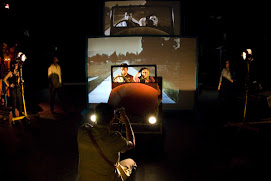
But let’s end on a more up-beat note. One of the most stunning theatrical combinations of live performance and projections I’ve seen was Between the Devil and the Deep Blue Sea from UK company 1927. Catch them on YouTube.
And the good news is: they’re returning to Sydney with a new show later this year.
18 February 2010
Moving on ...
Stories from the 428 moves on. Here we are, the 8 of us Week 2 writers with Gus at our first script meeting last week.


Photo: Leah McGirr
It's been interesting and deeply enjoyable to meet the other writers and hear their work; not to mention creating my own 2 short scenes: Pass and The Party. And realise that although our contributions are all quite different, there are echoes and overlaps—in content, voice and style.
Both my scenes, but particularly Pass, have an underscore of loss and mourning. Today, the 18 February, was my father's birthday. He died 18 months ago. In that time I've come to understand something of the subtle, complex, nuanced, insistent, unpredictable nature of grief—but it's not all bad, because I've also come to understand that, strange as it may sound, grief allows me to continue a relationship with my father.
Now for another jump-cut or whatever the writing equivalent of that is:
Recent anxiety: Am I endlessly rewriting the same material? And if I am, is this a problem, or do most artists return, perhaps obsessively, to mine their core material from different angles? What is my core material?
Recent reading: Delete: The Virtue of Forgetting in the Digital Age by Viktor Mayer-Schönberger. To remember was once difficult and costly and forgetting was the norm, but in our digital world this has flipped, and now remembering is the default.
Recent listening: Don Byron plays the music of Mickey Katz. Can Jewish musicians play jazz, can an African-American clarinetist play klezmer? Absolutely.
10 February 2010
Stories from the 428
I’m one of 16 writers involved in an unusual project called Stories from the 428.

It’s the brainchild of the dynamic Gus Supple, and this is what she has to say about it:
Thousands of people everyday travel on the buses and trains of Sydney—to work, to school, to meet friends or family. Though a necessary part of life in the city, public transport is an unknowing catalyst to creation. Many of us use our train or bus rides to message friends, read a book, write a card, read a newspaper, make notes in a diary. And the buses become a form of mobile office, taking us from A to B while we make plans or take notes.
Harnessing the talents of some of Sydney’s most dynamic writers, Stories from the 428 finds the sublime and extraordinary in the everyday bus ride and transports it on stage.
Inspired by conversations, scenes from the bus window, overseen text messages or perhaps the person sitting across from them, a group of 8 playwrights per week will collaborate to create a unique and surprising theatrical experience centred around the 428 bus route.
I was drawn to this for a number of reasons, but 2 in particular. I’m a passionate advocate for public transport, (I haven’t had a car for years) and in the late 1990s I lived in Dulwich Hill and travelled frequently on the 428 bus. My second main reason for joining Stories from the 428 was that it was all going to happen fast, fast, fast. We’d catch the bus, write our scripts, rehearse, and put them on over the course of a couple of months. When the gap between starting to write a play and opening night can stretch for years, this appealed to me. By way of contrast, I began Songket early 1997 and by the time it finally went on mid 2003, I had to work hard to rekindle my interest. To paraphrase the announcers on the London Underground: Mind that gap!
Stories from the 428
Week One: Wednesday 24—Saturday 27 March at 8:00 pm & Sunday 28 March at 5:00 pm.
Week Two: Wednesday 31 March--Saturday 3 April at 8:00 pm & Sunday 4 April at 5:00 pm.
Sidetrack Theatre, 142 Addison Road, Marrickville. (The 428 bus stops just outside.)
In the meantime, check out the project’s website: http://www.storiesfromthe428.com/ and Facebook page.
25 January 2010
Absolutely no sofas
Let's begin with sofas and how much I loathe them on stage. Especially ratty brown ones. I often write ‘absolutely no sofas’ in the production notes of a script, and with one terrible exception (an armchair) back in 2000, I’ve managed to keep soft furnishings out of my work. If you want to see couches, go to Ikea.
To me, sofas on stage are the theatrical equivalent of bookshelves in documentary films—the expert interviewed in front of his packed bookcase. This is not because I’ve got anything against domestic or office décor per se, (I love books and have crowded shelves of my own) it’s because a sofa represents a certain kind of play and production.
At various points I’ve tried to write these more traditional narrative dramas with plots and character journeys and naturalistically-inclined dialogue. The kinds of plays that get programmed in subscription seasons. What usually happens though, is I get to about page 5 and complete anarchy has broken out—I want to introduce a robot or a flock of singing sheep, or I find that one of my sensible characters has flipped his arc to riff on the difference between moths and butterflies, which, BTW, is not night and day. From time to time, generally when I’m looking at a 2-digit bank balance, I’ve berated myself for not trying harder to write this kind of play. But not any more. This is the year I finally admit that I don’t much like conventional narrative drama, and I don’t want to write the stuff. It’s not my shtick. So my motto for 2010 is: embrace your inner maverick.
Speaking of which, I saw Tim Key’s show The Slutcracker on Saturday. A wonderful and wonderfully idiosyncratic mish-mash of poetry, performance, film, philosophical nuggets and improv. It’s daggy and meandering and clever and funny, and best of all, utterly unpredictable. Unlike the STC’s Tot Mom. After 5 minutes, I knew where that was going. The critics loved it, as did a number of friends and colleagues. What can I say? It had a lot of chairs of the hard, un-upholstered variety, but at least it had no sofas.
23 January 2010
Research fever
Years ago, for fun, I did an online psychology test designed to reveal your particular character strengths and inclinations. Curiosity came out as my number one, which perhaps explains why I find myself, not yet 4 weeks into the new year, in a research frenzy. Other writers talk about ‘research fever’, but I fear I’ve gone past the fever and into the frenzy. The reason?—weeds.

My desk is a Manhattan skyline of books about weeds. Texts recent and old, scientific pamphlets, surveys, fieldguides, fictional weeds, Australian weeds, foreign weeds, even sci-fi weeds. The floor is awash with printouts and pages of notes, my computer loaded with databases and login codes for various libraries.
A bit of backstory: Weeds are a long-standing interest of mine, and I’m researching them now for 2 projects. One is a personal essay/non-fiction piece for radio called Weeds Etc. The other is one of the 2 projects for which I’ve got a New Work grant from the Australia Council Literature Board: an unconventional memoir in 11 parts.

The difficulty—my difficult—is that everything I read suggests several more things to seek out and read, suggests other avenues of inquiry, spreads into new areas of imagining. And it’s all fascinating and absorbing and I just want to keep on finding out more …
So how much is enough? How do you know when to stop with the research and start with the writing? Begin drafting that first rough version of the script or chapter or poem? How do you decide what is necessary, and what is overkill? Can research become a way of avoiding the harder task of actually writing? Something like:
Research = relatively easy + comfortable
Writing = difficult ∴ put off for as long as possible
Although of course, the equation isn’t that simple. Because research is not only about digging for information, it’s also about thinking, about ideas marinating, about living with the material and its myriad possibilities. It’s about letting your sensibility permeate your findings, it’s about sticking one thing to another, and about the deep pleasure of discovery.
Nevertheless, I shall have to draw the line at some point and move into the writing phase. (Which may require further research because the 2 phases do not exist each in their neat separateness, but are parts of the one, somewhat elastic process that is writing ...) To that end I will stop this post here. (Is blogging another way to avoid writing the script or poem or essay in hand?) And return to the strange and captivating world of weeds.
17 December 2009
Download Eels ...
My 2008 radio feature There's Something About Eels ... is part of ABC Radio National's Beachpod, a selection of recent programs from their documentary archives. This means you can download Eels ... here. Happy listening!
17 November 2009
Dramaturgy & Dramaturgies #4
Following on from something in my previous post—the relatively limited dramaturgy available in this country to writers at the less traditional or more experimental end of the theatrical spectrum, I received an email about Dramaturgies #4 an event taking place in Melbourne in February 2010. Here's what they say:
'Dramaturgies #4 will be a national gathering of artists and arts thinkers working over three intensive days to explore new ecologies for dramaturgical practice as we face the challenges posed by shifting theatrical forms in the twenty-first century. The gathering will include daily working groups to discuss specific questions of dramaturgical practice that require a detailed examination and response … '
Here’s what I’d ask: If hybridity is the destiny of our 21st century world—and I think the jury is still out on that, for every trend there is a counter-trend, etc., etc.—then what kinds of dramaturgical ideas and strategies do we need to develop for the modular script? For transcultural, bi-lingual and multi-lingual writing? To deal with open texts, site specific theatre and promenade pieces? With flash mobs, spoken word and the many and various forms of solo performance? With emerging music-theatre genres, with web-based, online and games-inspired forms? What happens to a story when mobile technology takes your writing outside the theatre space? How does the architecture of a place shape or subsume your narrative, determine characters, amplify voices, cast its shadow on the way you write? What happens when your ‘stage’ is full of unrehearsed passers-by, subject to inclement weather and random happenings?
Sounds like Dramaturgies #4 is going to address some of these issues.
For more info or to register your interest, go to their website: http://www.dramaturgies.net/.
15 November 2009
Enough with the 'Shoulds'
I’ve been working on Random Red, a radio drama script, the brief for which is to revisit an old text in some way. Text is interpreted very broadly—it could be anything from a novel to an inscription on a gravestone—but it does have to predate the invention of radio. And my use of this text is equally open, so it can be an adaptation, an audacious reworking, or I can simply use the original text as a springboard to something else.
After a couple of false starts I decided that my old text would be Isaac Newton’s early notebooks, in particular his 1659 notebook with its colour recipes. Newton's interest in colour was enduring; he is famously the man who unwove the rainbow, and fractured light into its 7 constituent colours.
I got carried away, reading biographies, books about the history of colour, of calculus, of alchemy and astronomy. I carried out research in Cambridge and London during my stay in England. The only problem was, everything I read branched out into more possibilities, more tantalising leads to investigate. Which meant I arrived at a point where I had enough material and ideas for half a dozen scripts—but no clear story world for the one I’d been commissioned to write. This no doubt reveals something (perhaps rather too much?) about my writing process, but it’s a situation in which I often find myself. On the up-side however, I’ve found some of my best ideas while immersed in research for other projects.
I’m not, and never have been, a writer who plans out their script before they write it. I usually start with a collection of ideas, themes and metaphors. Sometimes with a musical form. Occasionally with a character or characters. Rarely with a detailed narrative. Never with plot. I begin writing to discover what it is I’m actually writing about. This time I began with 2 things. A form or style: I wanted to combine narrative and real-time dialogue, and a hazy sense of one character: I knew he was male, well into middle-age, and some kind of scientist. As points of departure go, this is loose and vague—even for me. So, not surprisingly, the writing has been stop-start.
All this is by way of a (long) preamble to explaining why I’ve read a lot of theatre reviews and blogs this last week. And been dismayed (and exasperated) by the overuse of one of my least favourite words: ‘Should’. Especially when directed at playwrights. Too many critics, bloggers, whoever and their dogs, telling playwrights how they should write and what their plays should do. Why do playwrights cop so much of this? No one seems to tell actors how they should act or designers what they should design to anything like the same degree. But it seems par for the course to bombard playwrights with ‘shoulds’.
Bit of an aside: why have we adopted this medical terminology of ‘script clinics’, ‘script doctors’, etc.? One London theatre company recently sent out a newsletter promoting their script clinic with a big red cross and the question: Is your writing practice in need of a check-up? What message does this give playwrights? All it does for me is conjure up the ridiculous image of a waiting room full of sick and bleeding plays.
Back to the ‘shoulds’. First reaction is that I’d like to tell those dispensing these pearls to stop telling us what we should do and write their own damn plays! A second, calmer, response is that question: why do playwrights get so much advice? Collective insecurity? The need to court those who program? Getting carried away by the collaborative nature of our work? Or perhaps it’s because, unlike say, playing the cello or performing somersaults on the trapeze, everyone feels they can write? Anyway, whatever the reason/s, I think a contributing factor is the notion of ‘rules’. Personally, when I hear the word ‘rules’ I run for the door. No, but seriously, the problem I have with ‘rules’ is (a). that they are predicated on the assumption that there is some universal notion of the perfect play, to which we all subscribe, (b). that ‘rules’ are not neutral and value-free, but derive from particular traditions and ideologies, and are answerable to certain interests (read the work of Trinh T. Minh-ha and Raúl Ruiz from the 1980s for more on this), and (c). despite what are no doubt the helpful intentions of many script gurus and dramaturgs, rules are often about control and gatekeeping as much as they are about the craft of theatre writing; any work perceived to be ‘breaking the rules’ can be safely shifted to the margins.
Of course this raises issues of dramaturgy, and a recurring preoccupation of mine: the relative lack of dramaturgical strategies and vocabulary for more experimental theatre writing, for work which is not primarily or essentially narrative drama, for work which is not about character arcs and plot progression. But now I’m starting to rant. Enough said.
BTW I’ve almost finished the first draft of Random Red. As for process here’s a favourite quote from Isaac Newton: ‘I keep the subject constantly before me and wait ’till the first dawnings open slowly, by little and little, into a full and clear light.’
06 November 2009
extempore 3

extempore 3 is out. The journal is edited by Miriam Zolin and this issue includes a bonus CD of contemporary Australian jazz, including a track by the wonderful Way Out West. Their 2002/3 CD Footscray Station remains one of my much-played favourites, and—directly and indirectly—has inspired performance texts, poems and spoken word pieces. You can also read my poem Learning (to love) the clarinet in this issue of extempore.
07 October 2009
Poetic Dialogue
Got back from England a week ago. My body clock has finally caught up with me on this side of the planet, and I find myself overcome with the urge to clear out—clean out over-stuffed filing drawers, old clothes, herbs and spices past their use-by-dates. I’d like to think this cleaning frenzy is simply a time of year thing—it is spring, after all, but I suspect I’m avoiding a radio script that I should be working on. It’s at that stage where I’ve done a lot of reading and research and made a lot of notes, but still, frustratingly, have no solid narrative or clear story world. Even the characters are fuzzy. Let’s hope inspiration comes to me as I fill garbage bags with papers and faded T-shirts …
Today I extended the cleaning jag to my computer and started deleting old emails. That’s when I came across a link to a 2007 article from The Guardian by Anthony Neilson. He’s basically telling playwrights not to be boring. No argument there. But this paragraph towards the end of the article caught my attention:
‘ … there’s a lot of poetic dialogue around. Sometimes a play is narratively accessible but the dialogue is mannered to the point of incomprehensibility. Some people like it, but I’m suspicious. Poetic dialogue, done badly, leaves no room for subtext. A lack of subtext is fundamentally undramatic. And boring.’
As a writer whose performance work is often described as ‘poetic’, my initial reaction to this statement was to disagree. I find naturalistic dialogue, when done badly, thin and pedestrian. It reduces theatre to work-a-day TV without the locations. Poetic dialogue can be subtle and work by suggestion and association; it can use metaphors to convey internal emotional states; it can sculpt language like designers use space or lighting designers compose with light; it can draw on and make manifest the inherent musicality of theatre.
Many years ago when workshopping Historia at an ANPC Conference, a dramaturg told me that actors find it hard to be emotional in non-naturalistic or poetic text. When he said that, I wanted to ask him: where does that leave Shakespeare? Not to mention those Jacobean dramatists I love like Webster, Middleton, Tourneur and Ford. Think of the candlelit and treacherous universe in which they moved, of sin unpunished, of innocence destroyed. Even the titles of their plays are strangely seductive, trapdoors to something beautiful and wicked that trickles beneath the surface of mortality: The Malcontents, The White Devil, The Broken Heart.
Since then, I’ve thought a lot about poetic dialogue, and I think Neilson’s got a point. Kind of. So here’s my riff on the pitfalls of the poetic in performance:
When a script gets labelled ‘poetic’ chances are its poetry and poetics won’t receive any further comment or critical input. This is unfortunate.
Poetry is a distilled, economical form of writing that can be many things—active, introspective, muscular, analytical, moving, funny, whimsical or robust. It can be direct and it can be plain in its syntax and metre. It can also be elusive. It requires discipline on the part of the playwright. It is not an excuse for a mud of adjectives, overblown description or a lack of dramatic action.
Whether I’m working on my own script or someone else’s, these are some of the questions I ask about the play’s poetics: Is the poetic lexicon sufficiently distinctive and varied? Or is it limited and predictable? Can it cut to the quick when it needs to, or does it circle aimlessly? Does it drift, or is it sharply focused? Does it invite the spectator into its world?
There’s more to say on the subject, of course, but I really should get back to that radio script. And to ‘keep myself on task’ here’s a favourite quote from Robert Wilson:
‘My ideal theatre would be a cross between the radio play and the silent movie. The problem with most theatre buildings for me is that they form a tight frame, the picture frame of the proscenium stage, which constricts and limits the fantasy. But when I listen to a radio play, I can look out the window and look at an airplane or a couple of lovers or the birds.’
01 September 2009
There's Something About Eels ...
There's Something About Eels … won the 2009 AWGIE (Australian Writers’ Guild) Award for best Original Radio Script. It was produced by ABC Radio National and broadcast on Radio Eye (a program the ABC management—for some mysterious reason—saw fit to axe at the end of 2008) on the 16 August 2008. Written & narrated by me, it was produced by Sharon Davis and sound engineer Russell Stapleton.

The eel has an image problem. Koalas, giant pandas, dolphins, butterflies, kittens—some of nature’s creatures are Hallmark-cute and appealing. Others inspire respect and awe. But some—like the eel—make us shudder. A slippery fish that lurks in the mud of river beds, or coils up from the ocean floor to scare divers. But there’s much more to the eel than meets the eye. It’s an elusive creature, and a tasty one—eels are one of the human race’s survival foods. A creature with not only a remarkable life cycle, but also one with a long cultural history across cultures and continents. There's Something About Eels … combines science, literature, history, anecdote, reverie and culinary art in a radio portrait of this maligned, misunderstood and unusual creature.
The eel has an image problem. Koalas, giant pandas, dolphins, butterflies, kittens—some of nature’s creatures are Hallmark-cute and appealing. Others inspire respect and awe. But some—like the eel—make us shudder. A slippery fish that lurks in the mud of river beds, or coils up from the ocean floor to scare divers. But there’s much more to the eel than meets the eye. It’s an elusive creature, and a tasty one—eels are one of the human race’s survival foods. A creature with not only a remarkable life cycle, but also one with a long cultural history across cultures and continents. There's Something About Eels … combines science, literature, history, anecdote, reverie and culinary art in a radio portrait of this maligned, misunderstood and unusual creature.
Subscribe to:
Posts (Atom)